
On August 1, Mastercard issued a “clarification statement” on the platform for the game, which was directly refuted by Valve (Steam parent). According to the Game Industry magazine V, it is clear that MasterCard does express concerns about adult content on Steam, but does not communicate directly with V, but through intermediaries.
In a statement issued on 1 August, the MasterCard stated: “There is no game reviewed and no requirement to restrict any activity on the game creation platform, contrary to media reports and allegations. Our payment networks act in accordance with the law. In short, we allow all legitimate purchases on the network. At the same time, we require businesses to put in place appropriate controls to ensure that MasterCards are not used for illicit purchases, including illegal adult content.”
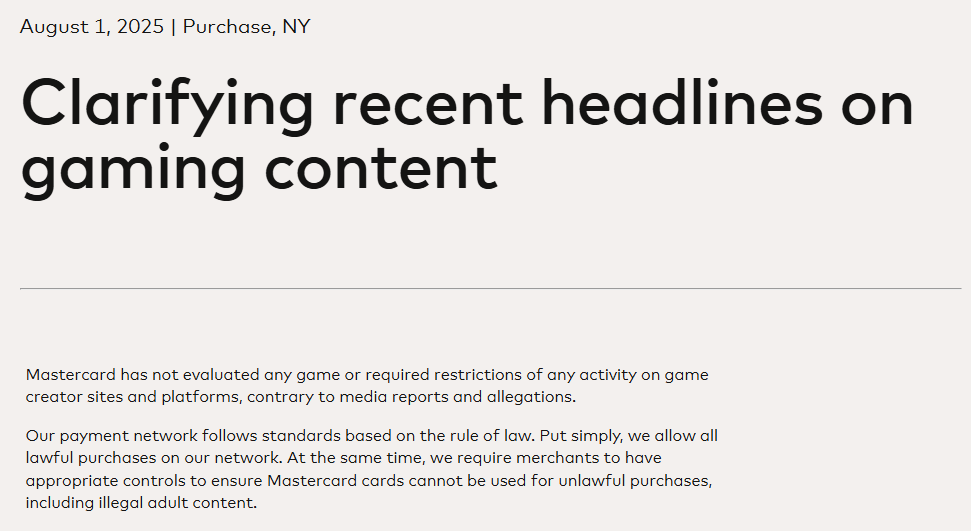
Statement of Everything
The statement sought to set aside direct responsibility and implied that its requirements were directed only at illegal content. However, during an interview with Kotaku the previous day, the spokesperson of V directly refuted everything. “Despite our request, the MasterCard did not communicate directly with Valve. The MasterCard communicates with the payment processor and his billing bank, and the payment processor conveys it to us, and we reply by outlining Steam’s policy since 2018: to work for the distribution of legally available games, the speaker stressed: “The payment processor rejected this position, citing in particular rule 5.12.7 of the MasterCard and the risk of a MasterCard brand.”
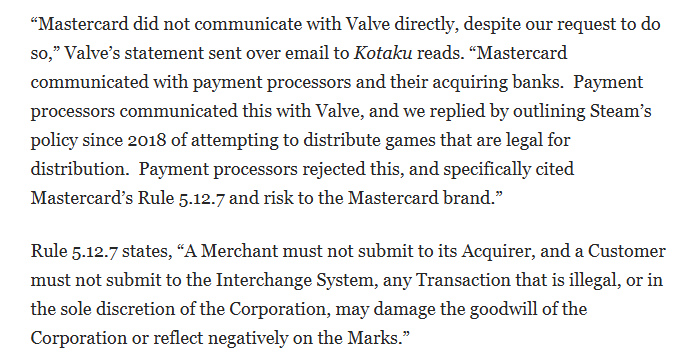
V Society Response
At the heart of the dispute lies rule 5.12.7 and the definition of non-compliance. Rule 5.12.7 is the core provision of the MasterCard rule on “unlawful or damaging brand dealings”. It provides that: “a merchant may not submit any illicit transaction to its receiving bank, nor may a customer submit to the liquidation system any transaction that, at the company’s discretion, may damage the goodwill of the company or adversely affect the trademark.”
The rule is long, but its key part is to define what the MasterCard considers to be “unacceptable” for sales associated with its brand: “a product or service (including images) that is sold that is “manifestly offensive and lacks serious artistic value” (e.g., but not limited to: images depicting involuntary sexual acts, sexual exploitation of minors, involuntary mutilation of limbs or parts of the body, or animal intercourse) or “any other material that the company considers to be unacceptable for sales associated with a trademark”.
The consequences of regulating this rule may include customer licensing reviews, audits, fines and even termination of cooperation with the company.
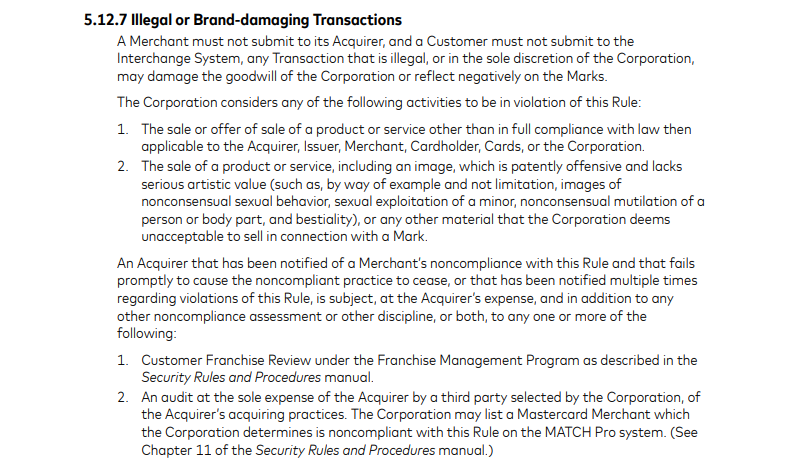
It’s 5.12.7 rule.
The MasterCard emphasized this rule to V, implying that it not only regards the apparent illegal product as an offence, but also covers any “manifestly offensive” elements that could damage its brand. The term “manifestly offensive content” generally refers to what is clearly unacceptable under community standards (e.g. explicit content or violent images that a common person may consider to be beyond the acceptance limit).
The key to this is that such content may not be in itself illegal, that “obscene” content, which is protected by the United States Freedom of Expression Act and which is not constitutionally protected, must meet the three criteria of Miller’s testing:
1. Whether the work as a whole attracts obscenity (i.e. sexual, sexual, excreta, sexual, unhealthy, degrading, shameful or pathological interest in nudity); 2. Whether the work is measured as a contemporary adult community standard, depicting or depicting sexual behaviour in a clearly offensive manner; 3. Whether the work as a whole lacks serious literary, artistic, political or scientific value.
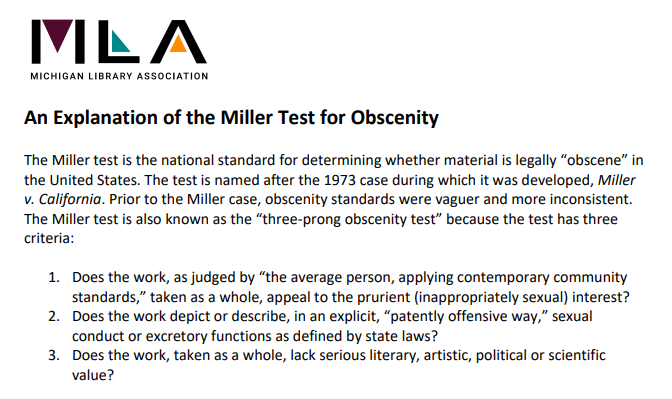
Miller tests.
The wording in the MasterCard rule means that the Miller test can be used to measure whether certain NSFW games are “manifestly offensive” and therefore violate its rules. This opens the door for a payer to limit content based on subjective brand image concerns rather than clear legal definitions.
Organizations such as the International Association of Game Developers (IGDA) and the British Game Trading Agency (UKIE) have expressed concern about adult content on the platform of the game under pressure from the payer. IGDA warns that this may force some developers into “silence or self-censorship”, especially LGBTQ+ creators, whose work may be misclassified or restricted by reference to the relevant subject or expression.
Valve ‘ s public rebuttal reveals a complex chain of payments in which the payment giants influence content through intermediaries and vague rules, pushing this debate on the freedom of digital content, commercial scrutiny of boundaries and the power to pay even deeper.