Anthropic, an investment by Amazon and Alphabet (the Google parent company), has published the most advanced AI models to date, Claude Opus 4 and Claude Sonnet 4, with an excellent ability to reason, which has generated widespread interest within the industry.
Anthropic is an AI start-up company supported by Amazon and Alphabet, which focuses on the development of safe and interpretable AI systems. On 23 May 2025, Anthropic announced the launch of Claude Opus 4 and Claude Sonnet 4, models that went significantly beyond previous generations in terms of coding, reasoning and AI proxy functions to counterbalance rivals such as OpenAI ‘ s GPS-4.1.
It was reported that the two models supported high automation, integrated search, reasoning, tool use and local document processing, and were able to extract key information and accumulate tacit knowledge. Claude Sonnet 4 replaces Sonnet 3.7, providing a better balance between performance and cost and suitable for a wide range of applications. The model was launched on 23 May 2025 on the AWS, Google Cloud, Snowflake Cortex AI and Databricks platforms to support free and paid schemes.
Anthropic describes Claude Opus 4 as the “best programming model for the world” and has performed well in the SWE-bench Verified benchmarking test, with a remarkable ability to solve real software problems. Support for a seven-hour autonomous coding mission, suitable for complex, long-term development. The ability to write and reason near human levels applies to research, application prototype development and complex project planning.
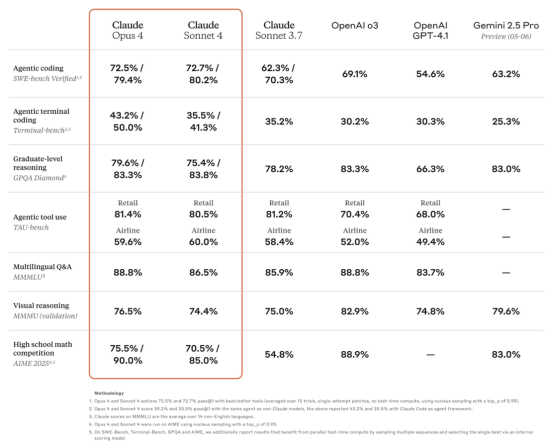
Claude Sonet 4 replaces Claude Sonet 3.7, providing higher performance and cost-efficiency and suitable for wider application. Excellence in reasoning, visual analysis and the use of tools has balanced performance against economy. A large number of local documents can be processed, key information extracted and a hidden knowledge base built to enhance the continuous learning capacity of AI agents.
Anthropic emphasizes that Claude 4 uses a hybrid reasoning structure that significantly enhances the ability to handle complex tasks. The two models have now been activated (ASL-3) for deployment and security standards, in line with Anthropic ‘ s policy of responsible expansion to ensure safety and control. In addition, model support interacts with external tools, applications and databases, further expanding the application landscape.
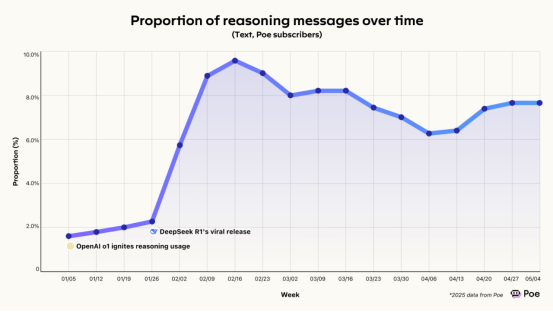
In 2025, the AI industry has significantly shifted towards reasoning models that simulate human thinking rather than simply matching them with training data. According to Poe ‘ s Spring 2025 Report on Trends in the Use of AI Models, the use of reasoning models has increased fivefold in just four months, from 2 per cent to 10 per cent of all AI interactions, and an increasing number of users are using AI as a thinker for role issues rather than a simple question-and-answer system.
Claude Opus 4 has a seven-hour autonomous line of reasoning that allows people to look at the role of artificial intelligence in knowledge-based work in the future. As models are upgraded, they are increasingly like authors rather than tools, able to perform continuous and complex tasks under little manual supervision.
This progress bodes well for a profound change in the way organizations build knowledge-based work. Work that once required the continued attention of humanity could now be entrusted to AI, and the systems could maintain focused and contextual information for hours or days. The impact on the economy and organization has been significant, particularly in areas such as the shortage of talent and high labour costs, such as software development.